Czech Frequency Dictionaries





Learn Czech Faster with the Most Common Czech Words
Czech is one of the most rewarding Slavic languages you can learn — and one of the most demanding. With 7 grammatical cases, grammatical aspect, and a rich declension system, Czech rewards learners who prioritise vocabulary from the start. Our Czech Frequency Dictionaries give you exactly that: a data-driven path through the 10,000 most common Czech words, ranked by how often native speakers actually use them.
Whether you're preparing for life in Prague, studying at a Czech university, working with Czech business partners, or exploring Slavic linguistics, starting with high-frequency vocabulary is the single highest-leverage investment you can make in your Czech.
Why Frequency Learning Works for Czech
Most Czech textbooks teach vocabulary thematically — airport vocabulary in lesson 1, bathroom objects in lesson 2. In theory it sounds logical. In practice, you spend hours memorising words you'll almost never use in real conversation.
Frequency-based learning flips this: you start with the words that appear most often in real Czech — the words that carry 90% of everyday speech, business communication, and written text. Research shows that knowing the 2,500 most common words in any language gives you roughly 95% coverage of everyday conversations. Our series is built on exactly this principle.
The word frequency data is derived from Czech subtitles — an ideal corpus because subtitles capture both spoken and written Czech, producing a vocabulary list that is genuinely practical for everyday use.
The Complete Czech Frequency Dictionary Series
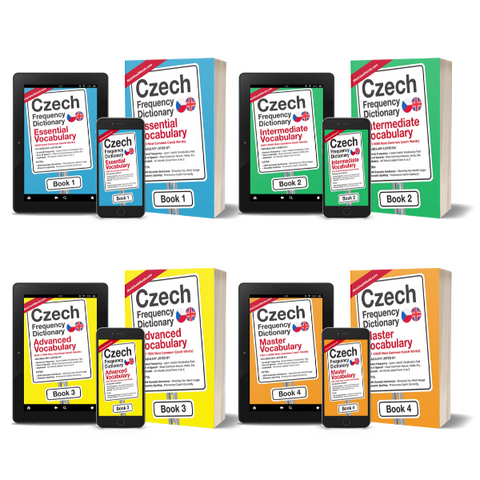
The series is broken into four volumes, each covering 2,500 words:
-
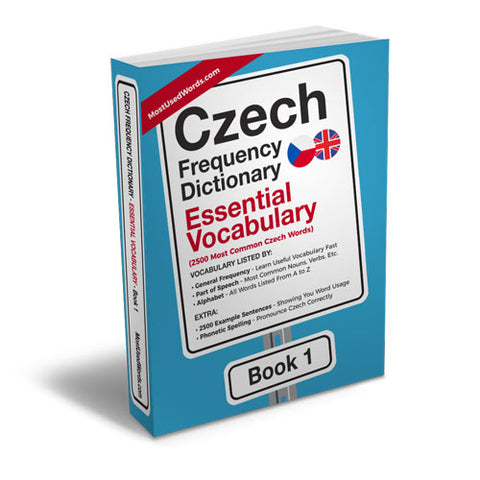
Czech Frequency Dictionary 1 — Essential Vocabulary
The 2,500 most common Czech words. Built for absolute beginners and false beginners who want a solid, practical foundation fast. -
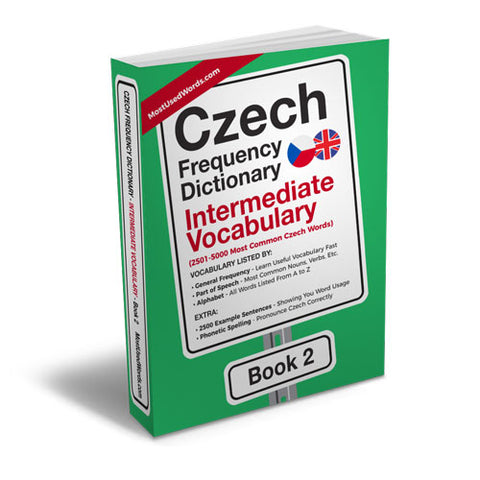
Czech Frequency Dictionary 2 — Intermediate Vocabulary
Words 2,501–5,000. Expands your range into more nuanced everyday language, narrative, and descriptive vocabulary. -
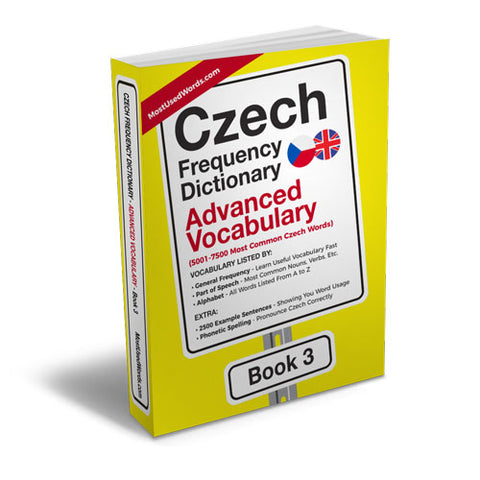
Czech Frequency Dictionary 3 — Advanced Vocabulary
Words 5,001–7,500. Covers academic, professional, and literary Czech that separates intermediate from advanced speakers. -
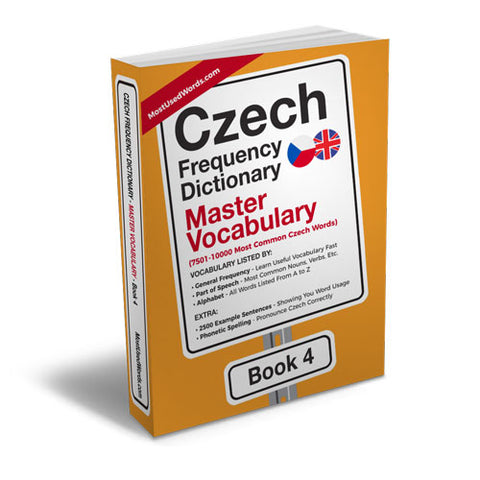
Czech Frequency Dictionary 4 — Master Vocabulary
Words 7,501–10,000. Near-native range: lower-frequency but high-value words found in journalism, literature, and specialist contexts.
What's Inside Each Volume
Every Czech Frequency Dictionary is organised into three sections:
-
General Frequency List
2,500 Czech words ranked by frequency, each with English translation, IPA phonetic transcription, and a bilingual sample sentence. Learn ten words a day and you'll complete a full volume in under a year — building a vocabulary most Czech learners never reach. -
Frequency by Part of Speech
Separate ranked lists for the most common Czech nouns, verbs, adjectives, adverbs, pronouns, prepositions, conjunctions, and numerals. Use these when you want to target a specific grammatical category — for example, building verb fluency or mastering the prepositions that govern Czech cases. -
Alphabetical Index
A full A–Z Czech–English dictionary in the back. Use it as a quick-reference lookup while reading, watching Czech television, or working through grammar exercises.
Parallel Text Sample Sentences
Every vocabulary entry includes a bilingual sample sentence — Czech on one side, English on the other. This parallel text approach does three things at once: it shows the word used naturally in context, gives you reading practice in Czech, and functions as a standalone bilingual reader. Each volume contains the equivalent of 70–90 pages of parallel Czech–English text. Complete all four and you will have read the equivalent of a short novel in Czech.
IPA Phonetic Transcription
Czech pronunciation is largely phonetic once you learn the rules — but the diacritics (č, š, ž, ř, ě, á, í, ú/ů) trip up most beginners. Every entry includes IPA phonetic spelling so you always know the correct pronunciation. The notoriously difficult ř sound alone can take months to master; at least you will always know exactly what you are aiming for.
Who Are These Books For?
- English speakers learning Czech as a foreign language
- Heritage speakers reconnecting with their Czech roots
- Expats moving to the Czech Republic or Slovakia
- Students in Czech language programmes or Slavic studies
- Business professionals working with Czech companies
- Language learners using Czech as a gateway to Polish, Slovak, or other West Slavic languages
Start Learning Czech the Smart Way
The Czech Frequency Dictionaries give you a clear, structured path through the vocabulary that matters most. No filler words, no rarely-used terms, no thematic detours. Just the 10,000 Czech words you are most likely to encounter — with everything you need to learn, pronounce, and use them correctly from day one.