Italian Frequency Dictionaries

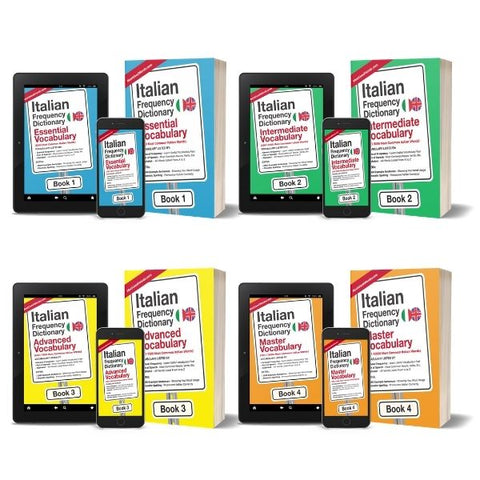




Italian Frequency Dictionaries: Learn the Words That Actually Matter
An Italian frequency dictionary lists Italian words in order of how often they appear in real-world usage — drawn from books, newspapers, film subtitles, and conversation. You learn the most useful words first, not whatever a course decided to cover in unit four.
The 1,000 most common Italian words account for roughly 85% of everyday conversation. Learn those first, then work up to 5,000 and 10,000 — and you'll understand nearly everything a native speaker says or writes.
What Every Entry Includes
Each word in our Italian frequency dictionaries comes with:
- Italian word — ranked by real-world frequency
- English translation
- IPA phonetic transcription — so you always know how to pronounce it correctly
- Part of speech
- Bilingual example sentence in Italian and English
This format is more useful than a bare vocabulary list — you see each word in context, understand how it functions grammatically, and have a real sentence you can use immediately.
Four Volumes, 10,000 Most Common Italian Words
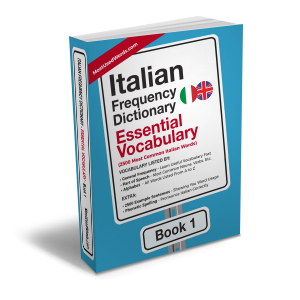
- Volume 1 — Essential Vocabulary: the 2,500 most common Italian words. Best starting point for beginners.
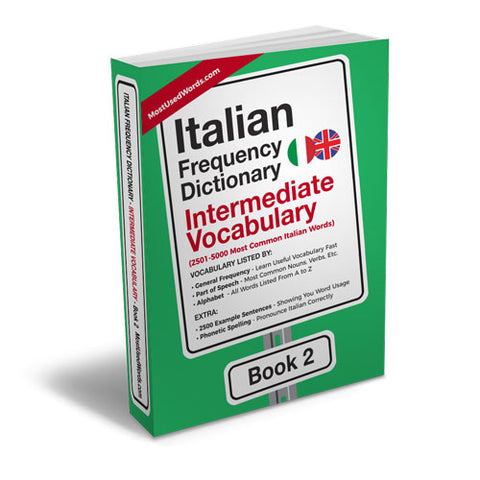
- Volume 2 — Intermediate Vocabulary: words 2,501–5,000. Covers most conversational topics.
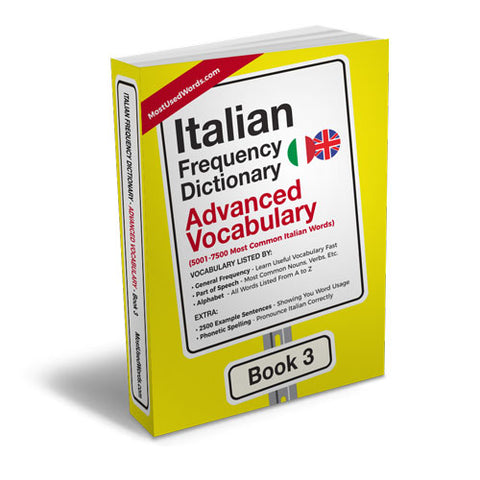
- Volume 3 — Advanced Vocabulary: words 5,001–7,500. Academic, professional, and cultural vocabulary.
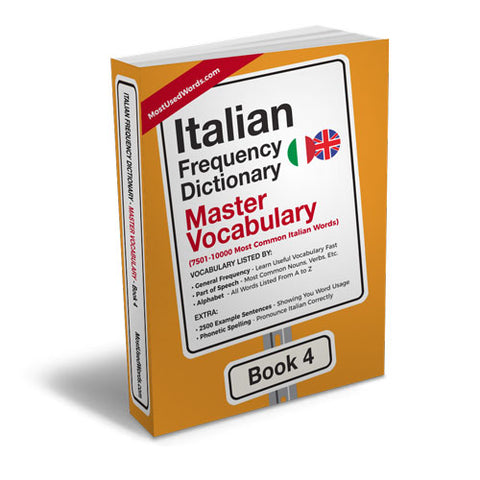
- Volume 4 — Master Vocabulary: words 7,501–10,000. Near-native range.
Italian Frequency Dictionary PDF — Instant Download
All four Italian frequency dictionary PDFs are available for instant download from this page. Each Italian frequency dictionary PDF is optimized for screen reading on tablets, e-readers, and phones — no waiting for shipping. Paperback editions are also on Amazon for learners who prefer print. The complete 4-volume bundle covers all 10,000 most common Italian words at the best per-word price.
Who Gets the Most from an Italian Frequency Dictionary
Beginners use Volume 1 to build a foundation in the 2,500 words that appear in nearly every conversation — more efficient than a themed textbook that teaches you furniture vocabulary before it teaches you verbs.
Intermediate learners use Volumes 2–3 to push through the plateau where basic Italian is easy but native content still feels fast. Frequency-based vocabulary study closes that gap faster than random immersion.
Advanced learners and heritage speakers use Volumes 3–4 to fill gaps in formal vocabulary, academic Italian, and lower-frequency registers where fluency still has rough edges.
Learn ten new Italian words per day and you'll have the 1,000 most common Italian words memorized in 100 days — always starting with the words you'll actually encounter, not the ones a curriculum decided you should know first.