
What Words Should You Learn? - A Closer Look At Vocabulary in Word Frequency Lists
A closer look at vocabulary in a frequency list.
Â
How can this help me learn a language?
Â
Maybe you are familiar with the thought. It is not an uncommon question. I get asked it quite a lot in regards to the frequency dictionaries.Â
Â
In today's article, we'll take a more in-depth look at the type of vocabulary in a frequency list. You can divide the classes into three types.Â
Â
If you know what to focus on, you will become fluent faster.
Â
Three levels of frequency
Â
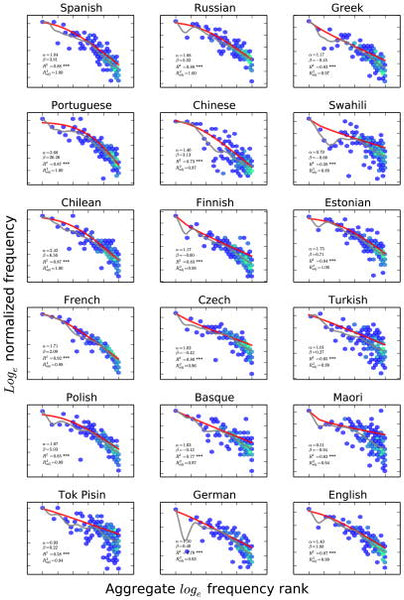
The frequency lists of different languages are similar. The same structural pattern shows itself repeatedly as Zipf's curve progresses from its upper part, middle and lower part.
Â
Words that make up the upper portion of the curve have the same function in all languages. The same goes for the middle and the lower segments.Â
Â
Upper part — function words
Â
The upper part of the curve comprises of function words. Words classed as:Â
Â
- determiners
- prepositions
- auxiliaries
- conjunctions
Â
All these words serve only as syntactic cement, one can say.Â
Â
They help us to put a sentence together in a grammatically correct way. It would be hard to create proper phrases without them.
Â
Middle part — general concepts
Â
If you were to weed out the upper part, the "function" words, from a language, you would start to see the first meaningful content words.Â
Â
These words have a concrete semantic meaning. They refer to a specific concept in your mind.
Â
- Time
- Like
- More
- People
Â
Middle segment words refer to these basic categories and concepts essential to human nature.
Â
At the same time, the middle segment is context-dependant.
Â
Words that form this part of Zipf's curve tend to change depending on the text or conversation topic.Â
Â
An example
Words like "aircon" or "HVAC" can reveal being surprisingly frequent if you're reading an airconditioning manual.Â
Â
But not so much in a blog about language learning, for example.
Â
Â
This middle part is your golden area of Return on Investment. You want to be able to express all concepts you want, without having to learn too much low-frequency input.
Â
Lower part — low-frequency words
Â
Everything that is not a function word or a general concept falls into the third category: low-frequency words.Â
Â
The larger the language corpus, the less frequent they occur. (A corpus is a massive amount of text. Linguists use these corpora to study languages.
Â
These low-frequency words neither carry a syntactic function nor hold a broad semantic meaning.Â
Â
These words have a precise application.Â
Â
A word like "thing" can be used in a multitude of ways and is helpful in many sentences.
Â
How often would you say something like "mouthwatering" or "onomatopoeia"? This type of word has very specific uses.
The key takeaway to learn any language fast?
Â
You want to learn words from the upper and middle segments of the frequency curve. Your 20% of effort that brings 80% of results:Â
If you want to accelerate your vocabulary growth, browse the MostUsedWords frequency dictionary series — available for Spanish, French, Italian, German, Greek, Romanian, Portuguese, Dutch, Polish, and more. Each volume covers 2,500 words in frequency order with bilingual example sentences and IPA phonetics.