
Bulgarian Frequency List
No two word lists are alike, as the sources used to create them vary. Word lists are often compiled to help people learn new vocabulary. They can be based on theme, such as words related to the grocery store, airport or bathroom. A drawback is that you might learn words that you will not use often, which could slow down your pace of learning. Other word lists are based on frequency, which is a great way to start learning new words since you use some words more often than others. Learning the top 1000 words in any language will account for roughly 80% of the language you use in your daily life. However, the downside is that learning by frequency has diminishing returns. If a language has 150,000 words in current use, the top 10,000 are enough to cover 98% of all spoken and 97% of a written language. So, at this point, it's better to learn from thematic lists. Look them up, or create your own thematic vocabulary list that is relevant to your situation. For example, if you work in finance, look up relevant terms and make your own list.
Before you begin learning Bulgarian vocabulary from a frequency list, it's important to know that spoken and written Bulgarian differ. This is because written Bulgarian uses different words than the spoken Bulgarian language. There is usually more complexity to written language, with a wider variety of words. You can further divide written language into historic, fiction, non-fiction, and academic vocabulary categories. However, this is often more useful to linguists than language learners. Therefore, if you are trying to learn Bulgarian vocabulary from a word list, you would need a list that encompasses both spoken and written language. We suggest finding a Bulgarian frequency list that includes both written and spoken Bulgarian, like the ones that we offer. We base our dictionaries on subtitles, because subtitles correlate both to spoken and written language.
Learning the right Bulgarian words first can help you do daily activities abroad. It makes you more confident in communicating, and can also help you better understand and respond to people from different cultures. If you learn some basic grammar rules, learn between 10 and 30 new words per day, and focus on reading, listening, speaking and writing, you will improve your proficiency.
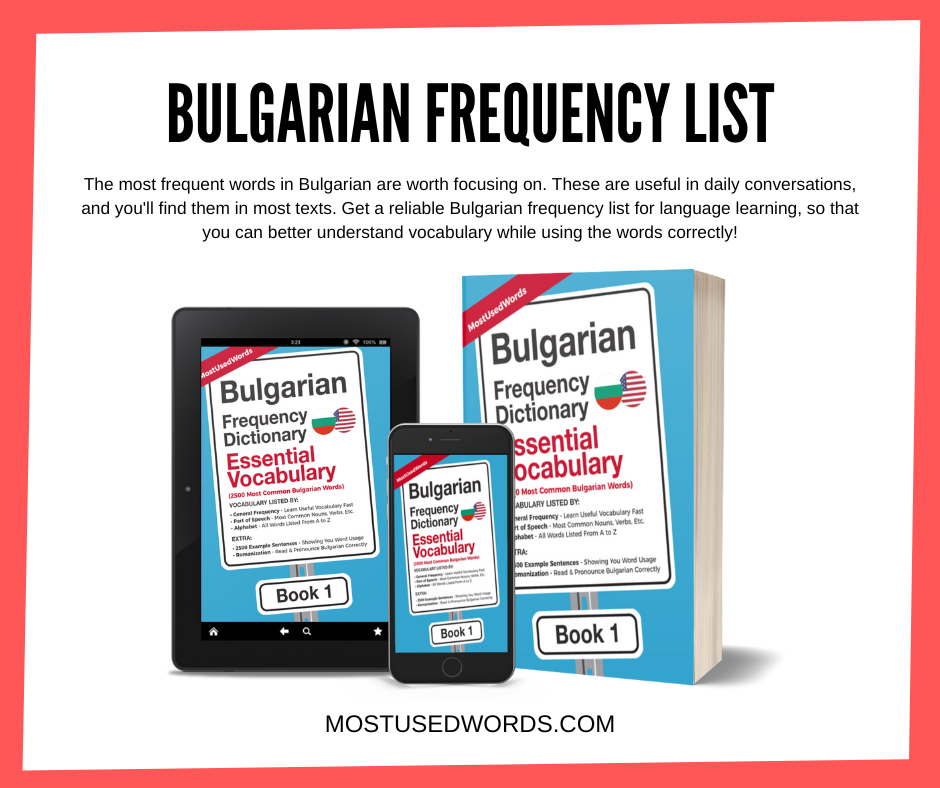
Our website has a collection of frequency dictionaries made for language learners. These dictionaries would prove invaluable in your learning journey. These contain the most frequent Bulgarian words in context. The books comes with a Bulgarian to English parallel text sample sentence. We also provide IPA phonetic spelling of Bulgarian words, so you’ll always know how to correctly pronounce foreign vocabulary.
The Bulgarian Frequency Dictionary for Beginners is available as paperback on Amazon. This link is an affiliate link. That means we might get a small commission if you make a purchase after clicking on the link.
Is Learning Through A Bulgarian Frequency List Effective?
For beginners, learning low frequency words like "equivocal" is not necessary. Research shows that we often repeat the same words and phrases over and over again. Even though there are better terms and phrases, we still use the exact same words every day. An example of this is the word “big”. Although there are many synonyms for "big", it is still used in 90% of all situations. It is important that you pay attention to words that deliver the most results quickly.
A frequency list is a list of words in a language that are ordered by frequency of use. You can quickly expand your vocabulary and gain a better understanding of a language by focusing on its most common words.
The Bulgarian frequency list can help you improve your vocabulary, but it should be used in conjunction with other language learning activities for the best results.
How Many Words Should You Know For Varying Levels of Fluency?

Beginner: If you're just starting to learn a language, 250-500 words will be enough to help you get by in everyday conversations. After just a week of study, you'll be able to hold basic conversations and get around in tourist situations. In most languages, 500 words will be plenty to help you get by in everyday life.
Conversational: You can get by in most languages with just 1,000 to 3,000 words. With that, you can ask people how they are doing, tell them something about your day, and get around in everyday situations like shopping and using public transportation.
Advanced: With 4,000-10,000 words, you become more proficient in a language. You will find yourself using more specialized vocabulary to discuss your professional field, current events, opinions, and other complex topics.
Fluent: You've reached an almost native level of vocabulary in many languages if you know around 10,000 words, with the requisite words for talking about nearly any topic in detail. In addition, you know enough words to recognize the meaning of the unfamiliar ones.
Native: World languages have different word counts, so it is hard to tell how many words native speakers actually know. The estimation of words that a native English speaker can know ranges from 10,000 to 65,000+.
A Bulgarian Frequency List For Learners
Here is a short list of the most frequent Bulgarian words you can use to acquire essential vocabulary. We compiled them for you to help make your own personal word list.
- на means of / to / on
- от means from
- че means that
- който means which
- и means and
- в means at / in
- ан means an
- да бъде means to be
- имам means to have
- чрез means by / through / via
- c or у means with / among
- неговата means his
- тя means she / her
- техен means their
- за да means to / in order to
- като means like / as
- всеки means all / each
- освен means but / except
- да направя means to do / to make
- да може means to be able to / can
- казвам means to tell, say
- да отида means to go
- друг means other, another
- този means this / that
- дали means if / whether
- ме means me
- вече means already
- да видиш means to see
- защото means because
- да дадеш means to give
- кога means when
- той means he
- тя means she
- тях means them
- много means very / a lot
- без means without
- време means time
- да знам means to know
- разбирам means find out / understand
- който means which
- Какво means what
- как means how
- по-горe means above
- моята means my / mine
- няколко means some
- някой means someone
- и means I
- също means also / too
- чак до means until / to
- година means year
- един means one
- две means two
- да искам means to want
- да обичаш means to love
- между means between / among
- така means like that / so
- първо means first
- от means from / since
- голям means large / great / big
- нито едното means not even / neither / nor
- нас means us
- пристигам means to arrive
- прекарвам means pass / spend
- да means yes
- не means no
- ден means day
- дължа means to owe
- вещ means thing / object
- толкова means so much / so many
- където means where
- сега means now
- след means after
- живот means life
- оставам means to remain / stay
- да мисля means to think
- говоря means to speak / talk
- да носят means to take / carry
- да напусна means to leave
- Нищо means nothing
- нов means new
- да намеря means to find
Above, we have given you a small Bulgarian frequency list so you can begin learning instantly, but this is not nearly enough to help you become fluent in the language. Get more valuable words with the MostUsedWords Bulgarian Frequency Dictionary. The dictionary follows the exact same format: Bulgarian vocabulary listed by frequency, frequency per part of speech and by alphabet.
Expanding your vocabulary can be as easy as learning new words in context. By understanding the meaning of words in the context of a sentence or conversation, you can quickly add new words to your ever-growing vocabulary. By seeing how new words are used in relation to other words and phrases, you can start to understand their meaning and how to use them yourself. And when you are repeatedly exposed to the words, you will be able to retain them more quickly.
Conclusion: Learning From a Frequency List Helps In Quickly Learning Bulgarian
The most frequent words in Bulgarian are worth focusing on. These are useful in daily conversations, and you'll find them in most texts. Get a reliable Bulgarian frequency list for language learning, so that you can better understand vocabularies, while using the words correctly.
By focusing on the most frequently used words, learning from a frequency list can help you quickly expand your vocabulary in Bulgarian. Remember that a frequency list is only one aspect of language learning and becoming fluent in Bulgarian. You can efficiently build your vocabulary and improve your overall understanding of the language by using a frequency list as one tool in your language learning arsenal.
We recommend our Bulgarian Frequency Dictionary available on our website. Our dictionary have sample sentences for each Bulgarian word on the list. The context in which each word is used will help you understand its meaning.
Improve Your Bulgarian with a Frequency Dictionary (Updated 2026)
Research consistently shows that mastering the top 1,000–3,000 most common words unlocks comprehension of 80–95% of everyday text and conversation. Our Bulgarian Frequency Dictionary series is built around this principle: curated frequency-ranked word lists, bilingual example sentences in context, phonetic pronunciation, and part-of-speech data — covering A1 through C2 levels.