
A Greek Vocabulary List For Learners
If you don’t know where to start learning Greek, we made a Greek vocabulary list for you. You can use this as your personal list for vocabulary recap every week. The Greek words are listed by how often they are used. We also provide you with detailed grammatical information, and part of speech. We also provide you with IPA phonetic spelling, so you always know how to pronounce words correctly. Each entry comes with a bilingual sample sentence, so you can see them being used in context. They also provide you with bilingual reading practice.
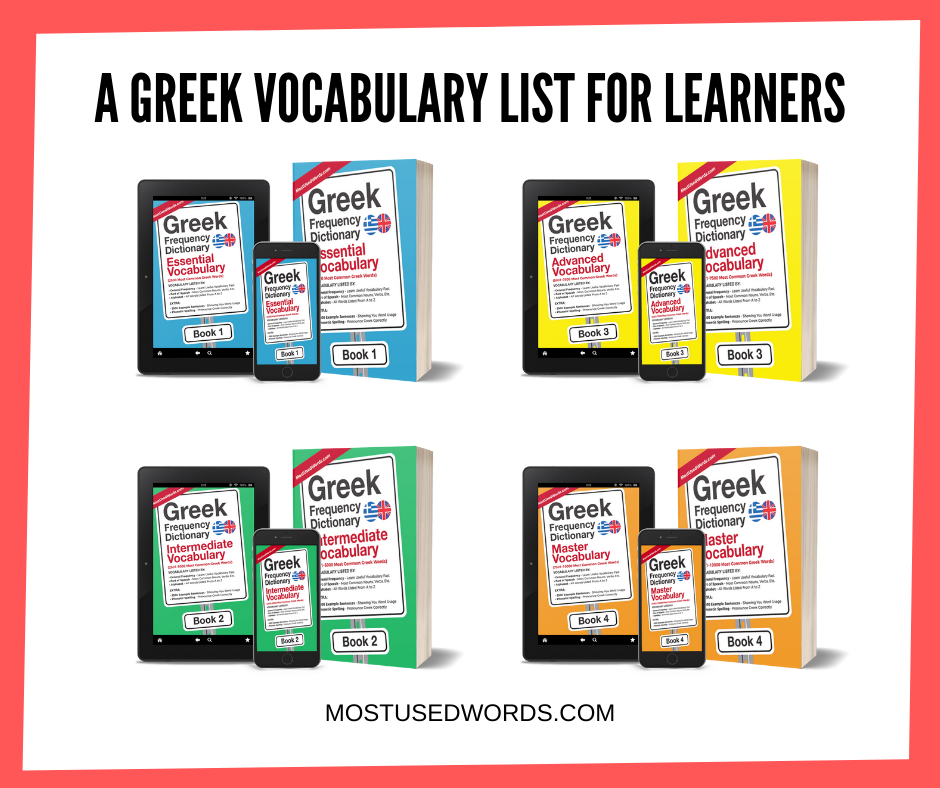
MostUsedWords Frequency Dictionaries can be downloaded as ebooks from our website. They are also available as paperbacks on Amazon. These dictionaries provide vocabulary in various levels of fluency: beginners, intermediates, advanced, and near-fluent vocabulary for learners. These links above are affiliate links. Meaning, we might get a small commission if you make a purchase through these links, at no extra cost to you.
How Many Words Should You Know To Achieve Fluency At Different Levels?

Beginner – 250 to 500 words should suffice if you are just beginning to learn a language. You'll be able to hold basic conversations and navigate in tourist situations after just one week of studying. 500 words is enough to get you through everyday life in most languages.
Conversational – With only 1,000 to 3,000 words, you can communicate in almost all languages. You can then ask people about their day and tell them how you are doing.
Advanced – You will become more fluent in a language by learning between 4,000 and 10,000 words. This will allow you to use more specific vocabulary to discuss professional topics, current events, opinions and other complex topics. The 5000 most common Greek words bundle will allow you to take your language skills up a notch.
Fluent – With around 10,000 words in your vocabulary, you can speak about almost any topic with ease. Additionally, you can recognize unfamiliar words with enough knowledge. Save even more and get a bigger discount if you order the 10,000 most common Greek words at once.
Native – Word counts in different languages are not the same, so it can be difficult to estimate how many words native speakers know. An estimate of the number of words a native English speaker could know ranges between 10,000 and 65,000+
Greek Vocabulary List
The Foundation
These are the most commonly used words you can find in the Greek vocabulary. This is the key on how you can construct the most basic sentences or answers to basic questions.
naí means “yes”
óchi means “no”
katalavaíneis? means “do you understand?”
Den katalavaíno means “I don’t understand”
Den gnorízo means “I don’t know”
écho chatheí means “I'm lost”
den écho idéa means “I have no idea”
Den miláo elliniká means “I don’t speak Greek”
Introduce Yourself
Maybe you found yourself in a situation where you need to meet and chat with someone you don’t know. Here are some ways to introduce yourself to them:
to ónomá mou eínai… means “my name is…”
Eímai… means “I’m…”
pos se léne? means “what is your name?”
Eímai apó… means “I am from…”
What’s Up
These are ways to ask someone what’s going on with their lives or a specific situation. You can use these Greek words and phrases to start small talks:
Pós eísai? means “how are you?”
poia eínai ta néa sou? means “what’s up?”
pós páei? means “how‘s it going?”
ti káneis? means “what are you doing?”
ti symvaínei? means “what is happening?”
Etiquette Words
Etiquette can bring you to places around the world! Learn these polite Greek words:
Parakaló! means “you’re welcome!”
sas parakaloúme means “please”
Me synchoreís means “excuse me”
sygnómi means “sorry”
efcharistó means “thank you”
gítses means “bless you”
Essential Questions
These are the key questions you might use any time to any context:
ti? means “what?”
POU? means “who?”
póte? means “when?”
ópou? means “where?”
Giatí? means “why?”
oi opoíes? means “which?”
pos? means “how?”
Greek Pronouns
Pronouns are essential to make our sentences clearer, less awkward, and smoother. It is important to consider the gender of the noun to address them accordingly:
Egó means “I”
eseís means “you”
aftós means “he”
aftí means “she”
emeís means “we”
aftoí means “they”
Greetings
It’s a nice thing to know how to greet other people. You can start with a simple chaírete!:
chaírete means “hello”
kaliméra means “good morning”
kaló apógevma means “good afternoon” or “good evening”
kalinychta means “good night”
Saying Goodbye
It is polite to say "goodbye" and let the other person know you are leaving before you go:
antio sas means “goodbye”
ta léme argótera means “see you later”
ta léme means “see you”
ta léme ávrio means “see you tomorrow”
na prosécheis! means “take care!”
na echeis mia oraia mera! means “have a nice day!”
ta léme sýntoma! means “see you soon!”
Kaló taxídi! means “have a good trip!”
Days of the Week
Talking about specific times or dates, you should know how to say the days of the week:
Kyriakí means “Sunday”
Deftéra means “Monday”
Tríti means “Tuesday”
Tetárti means “Wednesday”
Pémpti means “Thursday”
Paraskeví means “Friday”
Sávvato means “Saturday”
Other Time Words
Of course you can’t miss the general terms used to address the time! Here are some:
prochthés means “day before yesterday”
echthés means “yesterday”
étos means “year”
iméra means “day”
mínas means “month”
aiónas means “century”
óra means “hour”
símera means “today”
evdomáda means “week”
charavgí means “dawn”
ávrio means “tomorrow”
proí means “morning”
mesánychta means “midnight”
mesiméri means “noon”
leptó means “minute”
nýchta means “night”
methávrio means “day after tomorrow”
defterólepta means “seconds”
apógevma means “afternoon”
Nuclear Family
Addressing your family member is necessary, isn't it? You should know how to address them in your target language so that when you speak to them or talk about them with others, they would know who you are talking about:
patéras means “father”
bampás means “dad”
mitéra means “mother”
mamá means “mom”
adelfós means “brother”
adelfí means “sister”
yiós means “son”
kóri means “daughter”
stení oikogéneia means “close family”
Personality and Emotions
With these Greek words, you can describe your feelings and other people’s character:
charoúmenos means “joyful”
asteíos means “funny”
sovarós means “serious”
ntropalós means “shy”
gennaíos means “brave”
trelós means “crazy”
efcharístisi means “content”
charoúmenos means “happy”
anísychos means “worried”
nevrikós means “nervous”
galínios means “tranquil”
iremía means “calm”
enthousiasménos means “excited”
Start Learning Today!

Although we provided you with a general Greek vocabulary list in this article, it isn’t enough to achieve a level of actual fluency in the language. Learn more with MostUsedWords Frequency Dictionaries! Each dictionary follows the same layout. The only thing that differs is the range of vocabulary. You can download them as ebooks on our website, or as paperbacks on Amazon.
Each of the dictionaries contains English translations of the Greek words, accompanied by example sentences to know the right use of words in context. Each word also has IPA phonetic spelling as pronunciation guide, as well as a detailed part of speech information!
- 2500 Most Common Greek Words for Beginners
- 2501-5000 Most Common Greek Words for Intermediates
- 5001-7500 Most Common Greek Words for Advanced Students
- 7501-10,000 Most Common Greek Words for Near-Fluent Learners
You can expand your vocabulary by learning new words through context. Reading can help you to understand the flow and grammar, since this mimics natural language learning and will help you learn new vocabulary by allowing you to use context. You'll be able to retain words quicker if you are exposed to them repeatedly.
Improve Your Greek with a Frequency Dictionary (Updated 2026)
Research consistently shows that mastering the top 1,000–3,000 most common words unlocks comprehension of 80–95% of everyday text and conversation. Our Greek Frequency Dictionary series is built around this principle: curated frequency-ranked word lists, bilingual example sentences in context, phonetic pronunciation, and part-of-speech data — covering A1 through C2 levels.