

Learn Common German Words Quickly in 2026
Updated for 2026, learning German is easier than you might think. If you want to learn German but don't have time for long courses, focus on mastering the top 1,000 common German words.
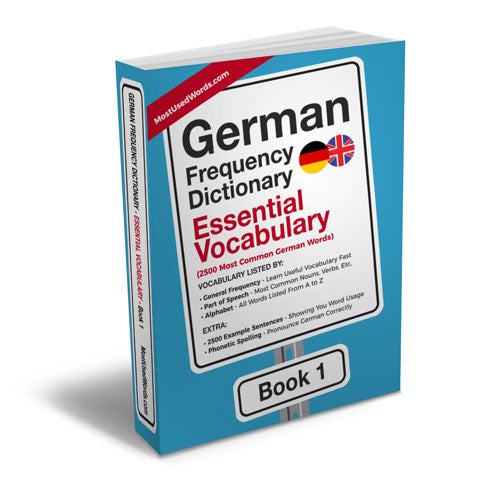
2,500 most common German words with IPA pronunciation & bilingual example sentences
The Importance of Common German Words
Knowing just 1,000 common German words can help you understand up to 85% of all daily conversations and texts in German.
German grammar rules might seem daunting at first, but not every word is equally important. The top 100 most used German words account for half of the language's everyday usage. Mastering the 2,500 most common words covers 95% of daily spoken communication and 98% of written text.
While achieving perfect fluency in any language is challenging, you can aim to be conversationally fluent with these essential German vocabulary terms.
What Can You Do With Common German Words?
Want to improve your German?
The German Frequency Dictionary series covers the 10,000 most common German words — ranked by how often native speakers actually use them, with IPA pronunciation, English translations, and bilingual example sentences at every level.
Browse all 4 volumes →With the core German vocabulary of just 1,000 most used words, you'll be able to:
- Talk about yourself and your family
- Engage in small talk topics
- Discuss the weather
- Ask for directions
- Order food in a restaurant
- Describe things and feelings
- Buy items in a shop
Frequently Used German Phrases
Expand your vocabulary with these common phrases:
- Good morning — Guten Morgen
- Good afternoon — Guten Tag
- Good evening — Guten Abend
- Hello, my name is ... — Hallo, mein Name ist ...
- What is your name? — Wie heißen Sie?
- How are you? — Wie geht es dir?
- I am fine — Ich bin ok
- Nice to meet you — Freut mich, dich kennenzulernen
- Goodbye — Auf Wiedersehen
- See you later — Bis später
- Where is the restroom? — Wo ist die Toilette?
- Excuse me — Entschuldigung
- Please — Bitte
- Thank you — Vielen Dank
- I'm sorry — (Es) tut mir Leid
- You're welcome — Bitte
- How much does it cost? — Wieviel kostet das?
- Yes — Ja | No — Nein
- I do not understand — Ich verstehe nicht
- Please speak slower — Könnten Sie bitte langsamer sprechen
User Testimonials: Success Stories from Learning Common German Words
Learners who focused on common German words have reported significant progress in their language skills. For example, Sarah learned to order food and ask for directions within a week of studying the most frequently used phrases.
Beginner German Vocabulary Tips
To start learning German effectively:
- Focus on both spoken and written German
- Use bilingual sample sentences for context
- Learn lemmatized headwords (not raw conjugated forms)
Professional Benefits of Learning Common German Words
Mastery of common German words can significantly enhance your career opportunities. German is one of the most important languages globally, with a strong economy and significant influence in scientific research.
How to Start Learning Common German Words
To build your vocabulary systematically:
- Set daily goals: 10 words/day reaches the 1,000-word milestone in 100 days; 20/day takes you there in 50 days.
- Use spaced repetition techniques like flashcards or Anki to retain what you study.
Interactive Learning: Quizzes and Games for Common German Words
Incorporate interactive elements such as quizzes and games to make learning common German words more engaging. These tools can help reinforce your vocabulary in a fun way.
Build Your German Vocabulary Systematically
The fastest way to grow your German vocabulary is to start with the words you'll actually encounter every day. The German Frequency Dictionary covers the 2,500 most common German words, each with IPA pronunciation, an English translation, and bilingual example sentences.
Browse the full range of German frequency dictionaries to find the volume that matches your level.
Bettina
Hi,
where is the link to get the most common German phrases? I’d be interested.